Monday, October 09, 2006

The Domino effect: North Korea vs. Asia

Big News…

If you all aren't keeping up on news and, I don't mean the war in Iraq, you should know that tensions are running high, really high, over North Korea's Missile Test today. My last news report was about Abe's new post as Prime Minister. Since then, a series of non-stop actions have been taking place since Abe took office. From various sources I'll try to give you a time line. These series of events plague the Japanese news and are pretty remarkable to experience.

Here is what has been going on thus far…

Tuesday October 3rd:
On Tuesday, Abe heatedly denied Japanese Communist Party leader Kazuo Shii's (right) remark [that during a Diet session in 1997, Abe demanded "a modification" to the apology to wartime sex slaves who were forced to serve Japanese soldiers] that he was trying to change the pacifist Constitution to permit the Self-Defense Forces to go to war.

"Criticism that (our) purpose for revising the Constitution is to create a country that will engage in war overseas is completely off the target," Abe said, raising his voice.

But he failed to give any details about how he intended to revise the charter's Article 9, which prohibits collective defense and limits Japan's use of force only to self-defense.

North Korea says it plans nuclear test
North Korea's statement Tuesday that it will conduct a nuclear test "in the future" threatens to intensify the international standoff over its missile and atomic weapons programs and upset the already fragile balance in the region, according to analysts... A test would have "a significant impact" on public opinion in Japan and South Korea, perhaps fueling the nascent debate in Japan over whether it should develop nuclear weapons of its own.

Such an event would likely harden the U.S. position on the nuclear issue, as well as public opinion in Japan as well as in South Korea, and spark worries in China about its neighbors building up their militaries in response to a nuclear North Korea, analysts say.

"At the moment, North Korea is only saying that it has nuclear weapons. But if a nuclear test is carried out, there would no longer be any doubt as to whether North Korea is a nuclear power," a Western diplomat in Beijing said.

"It would become a completely different ballgame."

Wednesday October 4th:
Abe noncommittal on war stance
Prime Minister Shinzo Abe acknowledged Japan's wartime aggression but avoided giving his own opinion on the issue while speaking Tuesday at a Lower House plenary session. "I believe that politicians should be humble about speaking about war or history . . . because a politician's statements hold political and diplomatic meaning," Abe said during the Diet session.

U.S. hails summits
The United States on Monday welcomed Prime Minister Shinzo Abe's plans to visit China and South Korea in an effort to mend strained ties. "This is really a matter for those countries to work out and to discuss on their own," State Department deputy spokesman Tom Casey said. "We definitely want to see Japan have positive relations with all its neighbors, including (South) Korea and China." Noting that China, South Korea and Japan cooperated with the U.S. in having the U.N. Security Council adopt a resolution condemning North Korea's July missile launches.

Sunday October 8th:

China, Japan oppose N Korea nuke test
Japan and China agreed on Sunday that a North Korean nuclear test "cannot be tolerated." [Prime Minister Shinzo] Abe also urged the North [Koreans] to heed the joint message. The common ground emerged as a South Korean politician said a North Korean nuclear test was not imminent and that the North was ready to drop its plans if Washington engaged in direct talks.

Abe, whose country has felt increasingly threatened by North Korea's missile and nuclear programs, promised to put the nuclear-test threat at the top of his agenda in summit meetings in China. He meets with South Korean President Roh Moo-hyun in Seoul on Monday.

Nuke test unacceptable

The Japanese leader said he and Chinese President Hu Jintao found the prospect of a North Korean nuclear test unacceptable. "We need to prevent a nuclear North Korea," Abe told reporters after meeting with Hu. "We saw eye-to-eye that North Korea's announcement of a nuclear test cannot be tolerated because it is a great threat to East Asia and the international community."

Abe suggested that North Korea should pay attention to the agreement, coming as it did in a summit between two often estranged countries, one of which, China, is an ally of
North Korea.

"China, I must assume, has major influence," Abe said.

Monday October 9th:

Abe, Hu agree to push 'strategic' ties
Prime Minister Shinzo Abe (left) agreed Sunday with Chinese President Hu Jintao (right) that the two nations will push forward a "strategic" partnership, breaking the ice in a diplomatic relationship that in recent years has grown increasingly cold.

Their meeting was the first summit between the two Asian powers in more than a year. They shared common ground on the North Korean nuclear crisis. A joint statement released after the summit stated that "both sides expressed deep concern about recent situations over the Korean Peninsula, including the issue of nuclear tests."

"President Hu and I agreed that a North Korean nuclear test would be a threat to East Asia as well as the rest of the world and that we cannot accept it," Abe said at a post summit news conference. "This agreement sends a strong message to North Korea."

Monday at around 10:36 a.m.:

North Korea Conducts 'Historic' Nuclear Test

North Korea carried out their first-ever nuclear test on Monday at around 10:36 a.m. (9:36 p.m. EDT on Sunday), putting to rest any doubt that the country has been working to back up its claims of working towards nuclear capabilities.

According to the communist regime's official news agency, the test was executed safely with no harmful effects, saying that it "was carried out under a scientific consideration and careful calculation.” The North Korean news agency said that the "historic event" would "contribute to defending the peace and stability on the Korean Peninsula and in the area around it." President's Roh Moo-hyun's spokesperson, Yoon Tae-young, said that "Related countries are in consultations on the issue," and that Roh had called an emergency meeting to talk about responses to the news.

Shinzo Abe, Japan's new prime minister, arrived in Seoul on Monday in order to talk with President Roh about the damaged relations between the two respective nations as well as the recent nuclear threat North Korea made last Tuesday.

Japan's U.N. ambassador Kenzo Oshima, who leads the Security Council this month, said that "Should North Korea ignore calls of the international community, the Security Council will act consistent with its responsibility under the Charter of the United Nations." The Security Council is expected to discuss measures to be taken.

North Korea has shown that they are not to be underestimated or scoffed at. Though their missile tests proved to be "unsuccessful," and though they are not believed to possess the capability of reaching the U.S. with nuclear arms, it seems that the U.S. and the U.N. can no longer afford to rely on doubt to further delay significant action against North Korea.

------------------------------------------------------------------

It seems that the ball is rolling towards something intense. North Korea is acting against everything its neighbors are demanding. How this pans out is up to China's Leader Hu and Japan's New Prime Minister Shinzo Abe (who has been on the job a total of 15 days).

Out of this bazaar series of events comes here is some questions to think about:

1st: What is Korea's intentions? Is it power, money, or prestige?

2nd: For a over 5 years relations between Japan-China and Japan-S.Korea have been poor. However, in order to send a united message to N.Korea Japan, China, and S.Korea all need to work together. Will N.Korea's missile test bring the three North Asian Power players back to the table?

3rd: Will Shinzo Abe push to revise the charter's Article 9, which prohibits collective defense and limits Japan's use of force only to self-defense?

4th: Can Abe and his conservative party (The LDP) rally U.S.-Japan Support for an offensive position against N.Korea.

5th: How is this going to effect, nationally, political views of North Korea and will Tokyo make drastic changes in national security (like the U.S. has with the patriot act, FAA, etc.)?

I know first hand that it's on the news and has my host family worried. It's big news and it's on everyone's mind. My dad asked me earlier how Japan feels about Iraq and the war over there it's not in the news here, the issue is Korea and their recent aggressive behaviors. In President Bush's first term two planes hit the World Trade Center in New York and it changed everything... Now Korea threatens to test Nuclear Missiles in Shinzo Abe's first term, there's a chance that such an event could change Japan as 9/11 changed the U.S.

to be continued...

~J out.

Hokusei Gakuen University's Matsuri

On Friday, Saturday, and Sunday I helped out in our club's (Hi-C) Matsuri festival stand. Matsuri is different for everyone. About a week earlier the local shinto shrine had it's matsuri. Basically matsuri is just a festival event when clubs sell all different goods and host games for people to play and have fun.

Hi-C's plan was to make crepes, lots of crepes, and then sell them at their matsuri stand. Friday night they planned on making the crepe base and then all durring the next day they made them and sold them. In a weird series of events I got involved in making those crepes friday night. The atmosphere was pleasant and the people friendly. We make crepe bases till roughly 11:00pm that night in college apartments "Kirari."

The next day (Saturday); The weather was bad with wind and rain howling and the temp around 11 degrees celcius (i.e. cold). The club made all different types from chocolate to banana to you name it. The price was set at 200 yen- 300 yen. In the beginning they sold pretty good, but as the day rolled on the sales dropped slowly. Even though the sales were slow, I learned about Japanese marketing/selling stuff proceedure. So here's a crash course in selling to Japanese people.

To get people to come to your stand: You say, "Irashiemase." (en: please come in)
To get people to look and buy your wares you say: "Iraga desu ka?" (en: would you look/buy)
When they buy you bow (jap style) and say "Arigatoo Gozaimasu."

I did that all day until I decided to roll at around 4:30pm.

Now... from what I hear, the club didn't clean up good enough when they left at 6:00pm so the school banned the selling of crepes the next day. So, when I came back to check the stand on Sunday no one was there exept for a few people standing around. The plan changed from hanging out selling crepes to going karaoking in a karaoke hall in Odori. Shortly after, we left to go shopping for a minute or two where I found a cool traditional Japanese store.

After shopping we headed towards an awesome hole in the wall restraunt that opened up below into a really happening place. Through out the night we were fed Japanese dish after Japanese dish. It was a real great time to end the weekend.... KOMPAI! (en: cheers!)

~J

Saturday, October 07, 2006

BUNRAKU (or NINGYO JORURI)

Edit: Pics are up now! Enjoy!


Ok So here's the Puppet Show Post!

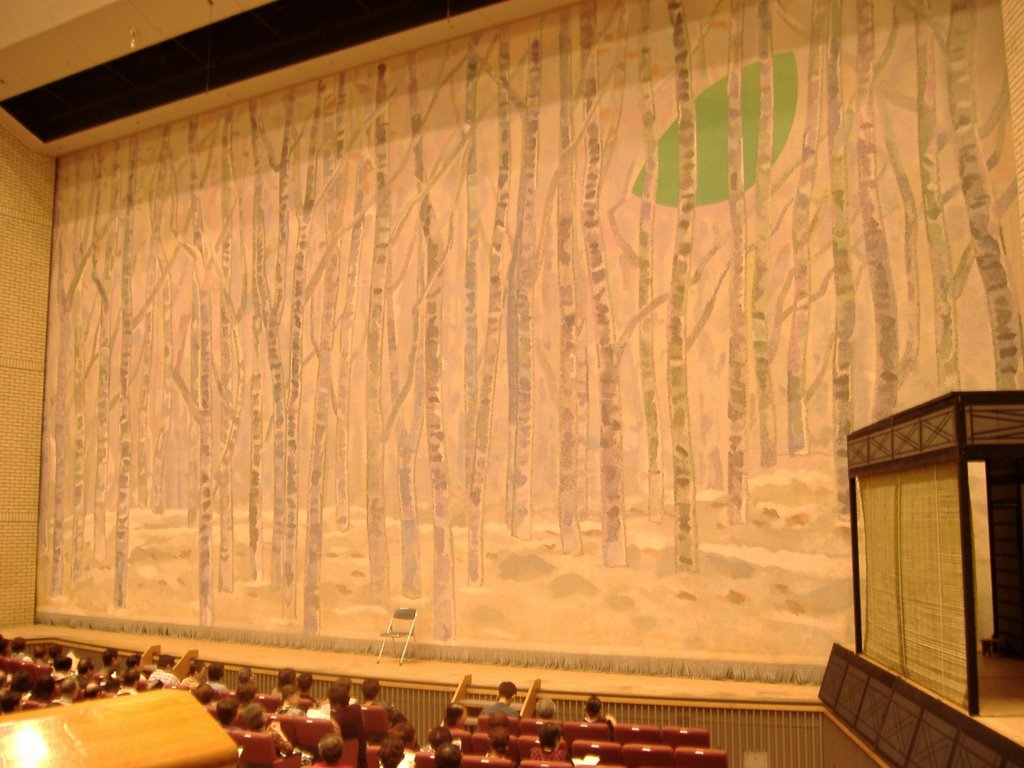
Last Thursday I was given the opportunity to go to a Bunraku or Traditional Japanese Puppet Show. The show was one stop past Odori park in Sapporo's Old Town. The cost for one person I heard was roughly $50 usd for each ticket, however the school picked up the tab. (Thanks!) There is a bit of humor to all of this, due to the fact that when I was trying to tell my host family I'd be going to a Bunraku performance; they didn't know what on earth Bunraku was. They had never been to bunraku, kabuki, or a noh performance before and they're Japanese! Not to worry, I'm sure there's something I haven't done in America before... ... ...but I can't think of it yet.
We went by subway. We started in Oyachi and got off at the station after Odori (the name I forget). The theater was located in a giant park. As we headed in, we were all given tickets with our seat number (ex. 2ね8) and we're seated accordingly. The "ne" in 2ne8 is just the order we were seated in according to the Japanese hiragana alphabet (あ、か、さ、た、なー). After being seated we waited for the play to begin. No one really knew what was about to happen, because no one in our group (Japanese included) had ever been to one.

If you don't know officially what Bunraku is... here's a great description from the Japan Art Council :

Bunraku is the traditional puppet theatre of Japan, a high-level stage art of which Japan is very proud of. “Bunraku” was originally the name of the theatre in which this puppet drama was performed, but gradually it came to be used as the name of the art itself and is today used as the official name of the puppet theatre. The art only came to be known as "Bunraku" around the end of the Meiji era (1868-1912); up until that time, the art was known as ayatsuri joruri shibai ("puppet joruri plays") or ningyo joruri, or "puppet narrative drama." Now,joruri is a type of shamisen music, and the name reflects that the puppet plays were performed to a joruri accompaniment. Bunraku's world renown stems not only from its high-quality artistic technique, but also from the high level of its joruri music and the unique nature of manipulating the puppets―each puppet requires three puppeteers to bring it to life. Throughout the world there are a number of types of puppet theatre, and they all treat with simple stories such as myths and legends. There is no other art that requires a whole day for its long, serious drama to unfold. Furthermore, in most of the world's puppet theatres, great pains have been taken to hide the manipulation of the puppeteers from the audience. There are several methods of achieving this: suspending the puppet from strings attached to the ceiling, as with marionettes; placing a hand within the puppet and moving it with the fingers, as with guignol puppets; and casting shadows upon a screen, as with the wayan kulit shadow puppets. But in Bunraku, the manipulators appear openly, in full view of the audience. These two characteristics, which make it completely different from the other puppet theatre traditions around the world, can be said to be the reason that Bunraku is called the most highly developed puppet theatre art in the world.

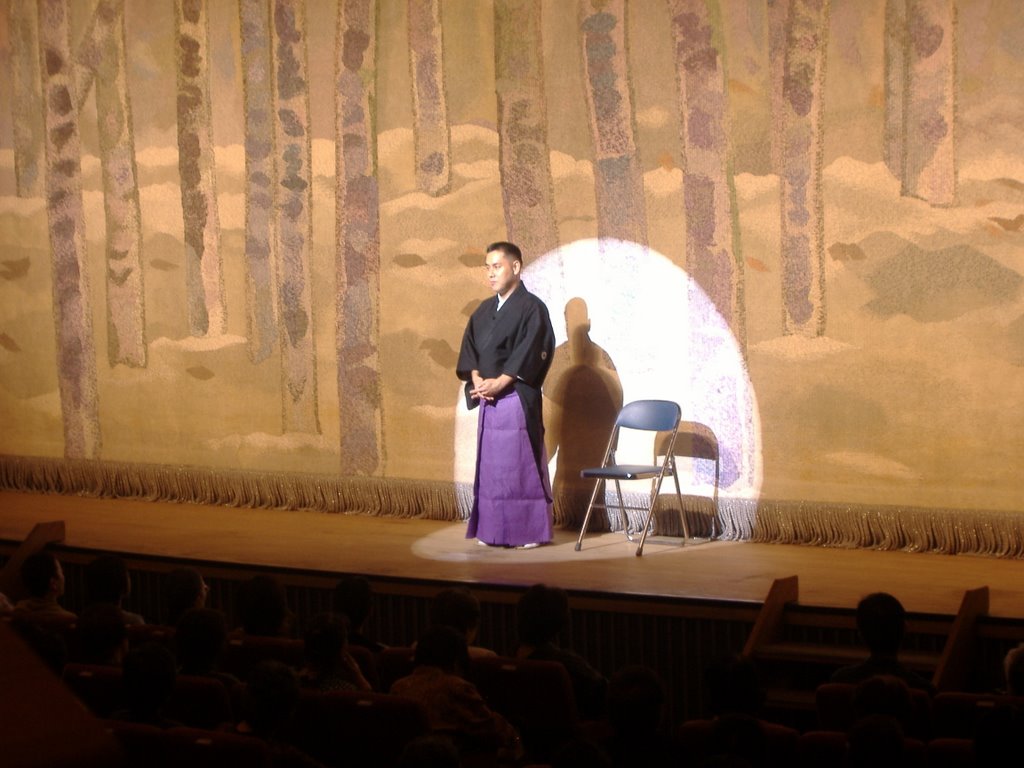
I don't know if this is what we actually experienced, but it was a highly sophisticated puppet show. The show began with a man walking to the stage and giving us a history lession on bunraku. This informational was of course in Japanese, in fact it was all in Japanese. He basically said where it was started and the elements of Bunraku and such and then he left. The next guy that showed up was the narrator who gave a speech on the elements of narrorating both the guy and gal's voices. In bunraku, there is no women at all so the narrator has to do both man and women's voices. The skill involved is intense and is taught the same way as the age old Master to Apprentice.

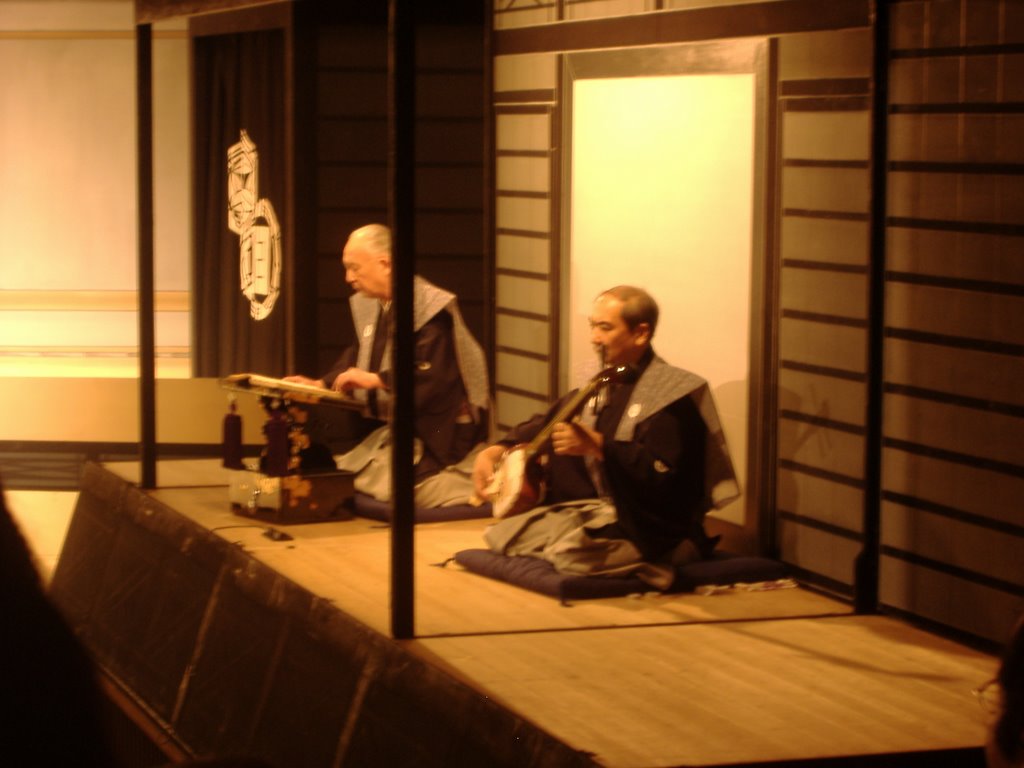
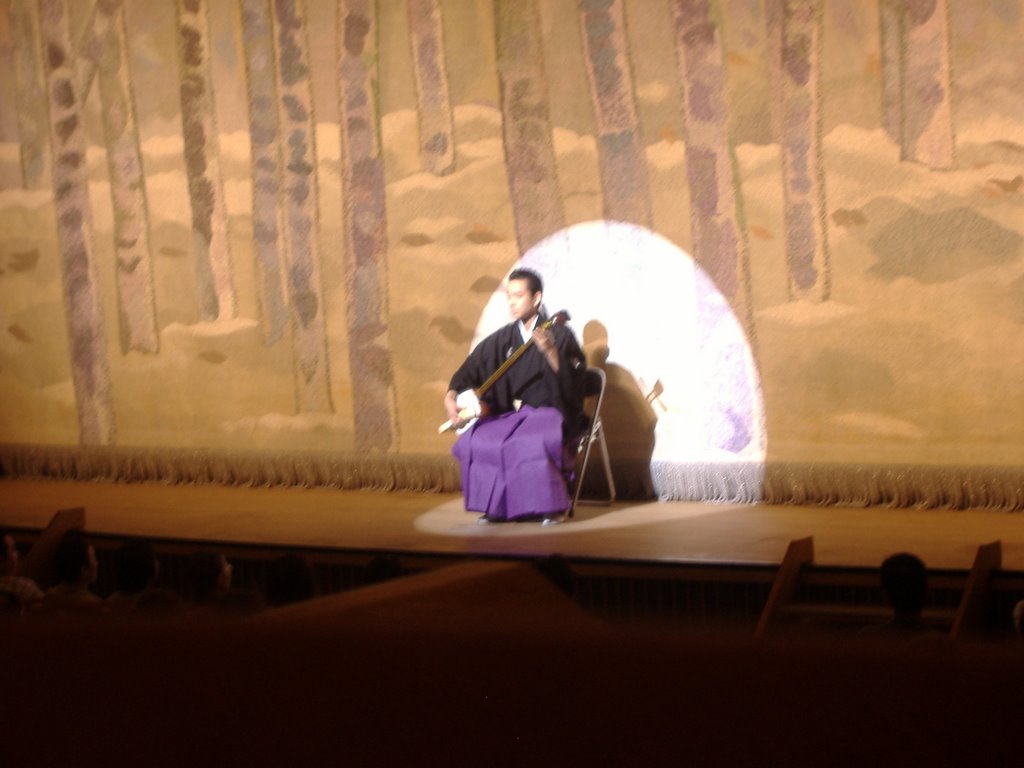
The next guy to enter the stage was the shaminsen guy who gave examples of playing and beats and assisting the narrator. He showed the audience all the parts of the Shaminsen and how he learned how to play the 3 stringed instrument. A note on Shaminsen is that it uses friction pegs so sometimes it goes out of tune, but honestly I wouldn't know if it was out of tune or in tune.

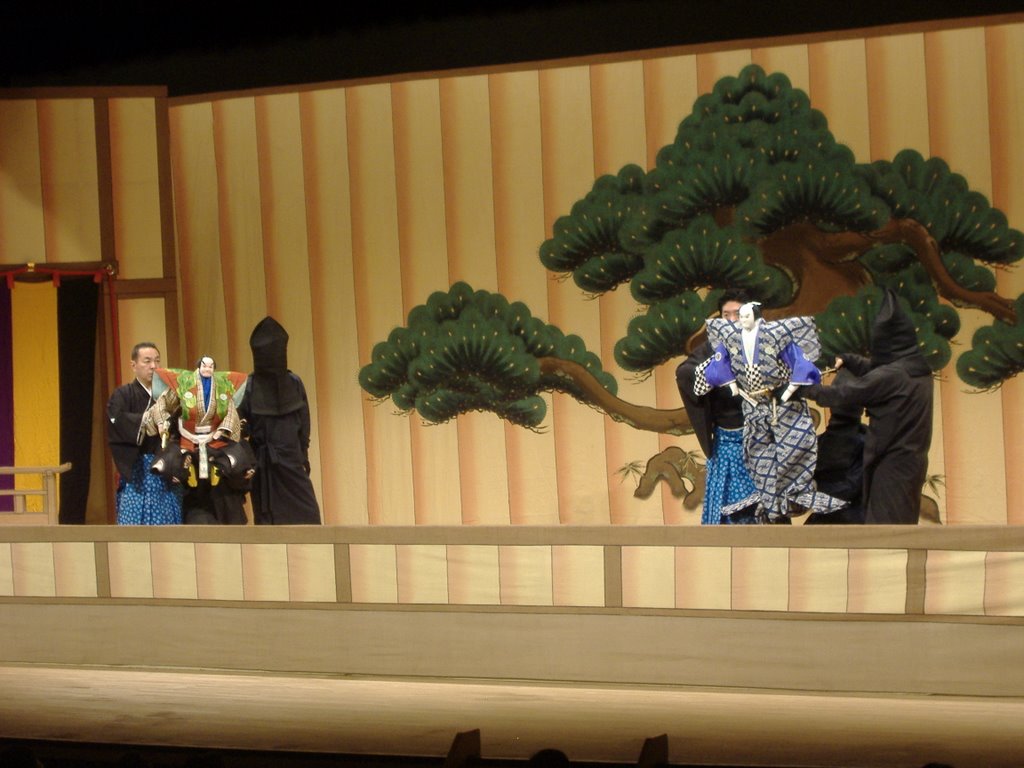
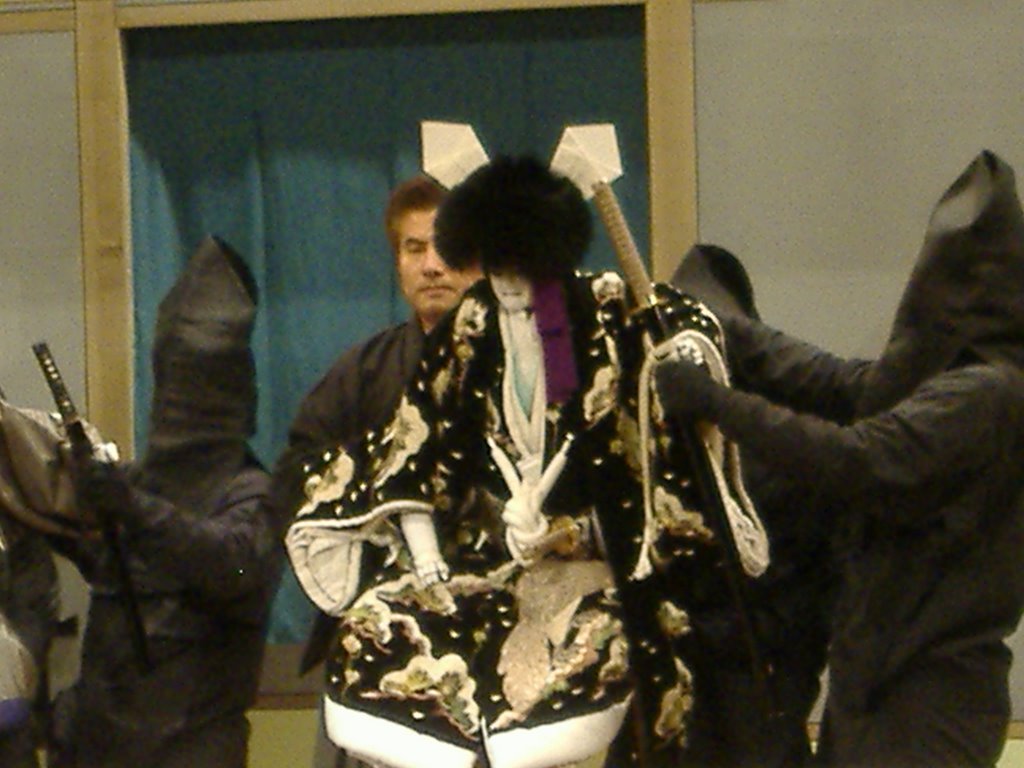
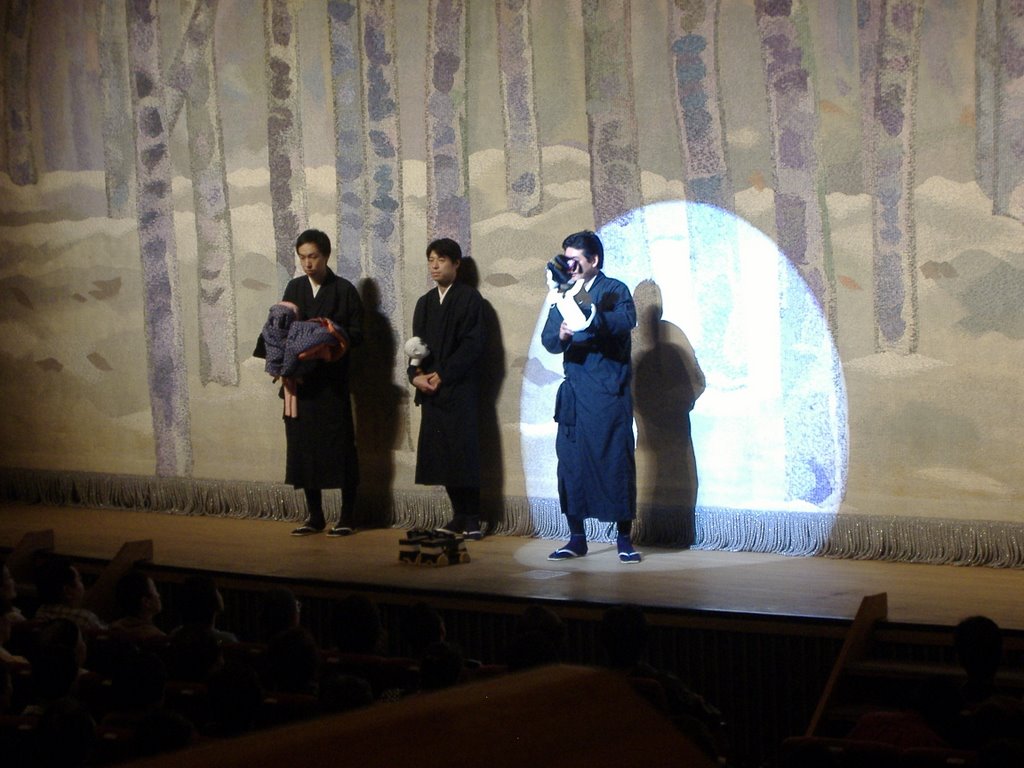
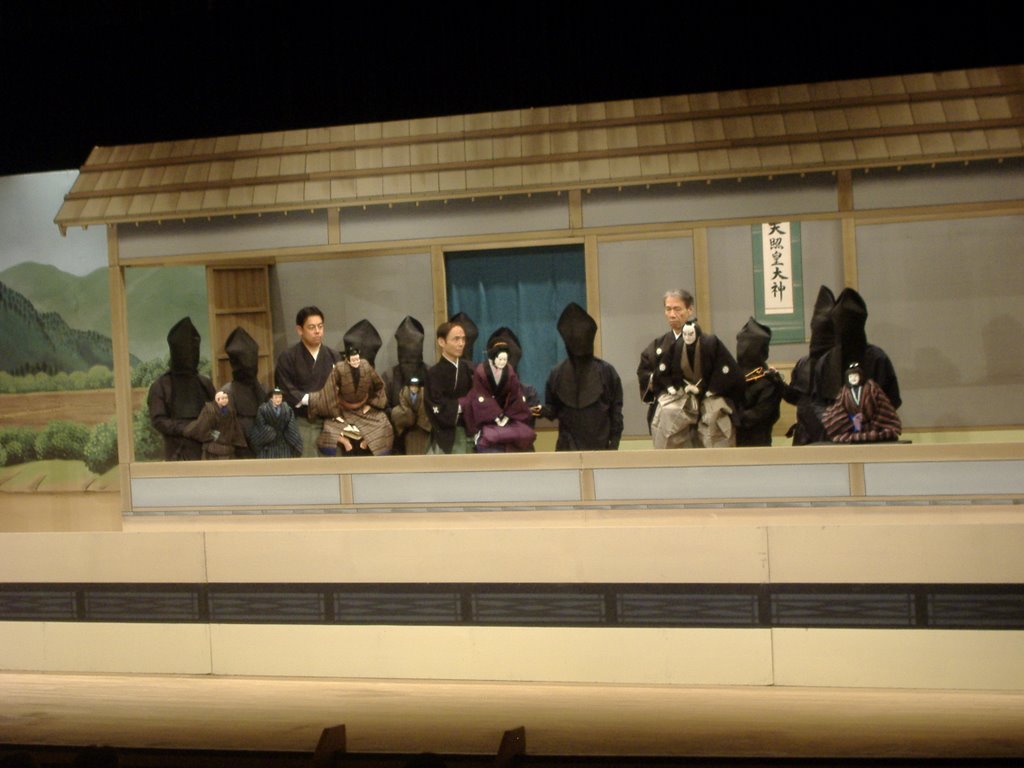
The Last guy came out with two other assistances who helped him with a large female puppet. This was the Puppeteer who demonstrated the skills of making a puppet come to life. The examples he showed the audience were facinating to say the least. The way he moved it made it come to life, not like puppets on Mr. Rodgers. This was just awesome how it made it bend and turn and bow like we do. The whole performance was performed in this masterful way that at times made you forget about the puppeteer and just imagine the puppets as people. Culturally, the main Puppeteer wears a white robe with a black robe over it. His head is exposed and he often makes the expressions his puppet makes in order to consume himself and the audience with realism. The other assistances however wear black robes with face masks so that only the puppet and the puppeteer is exposed. It's like any staff person at a show, concert, or public hall wears a black outfit to "disapear" so to speak.

When he left the performance began and the curtin went up. It was 1pm and we didn't get outta there until 4:30pm. The performance was awesome, I'm sure it'd be better if I knew what was going on, but I didn't. Not sure what I was seeing, I liked the outfits and the characters and shaminsens and stuff. My friend and I went and took some snap shots of the play, although I heard afterwards that pictures may not of been allowed. "Oh well" I say... sometimes it's easier to appologize then to ask permission, right? Plus, it's not about me anyway... it's about you all!

To review the entire performance would be crazy! I'll say it was equally cool as it was boring. Most of us might of dozed off for the slow scenes, but woke up to the cool scenes. I'll admit I was bored so instead of dozing, I took pictures... lots and lots of pictures (about 101 pics and short movies). Overall it was a good experience and a look at what Japan has to offer.


~J out


Friday, October 06, 2006

Kendo Club

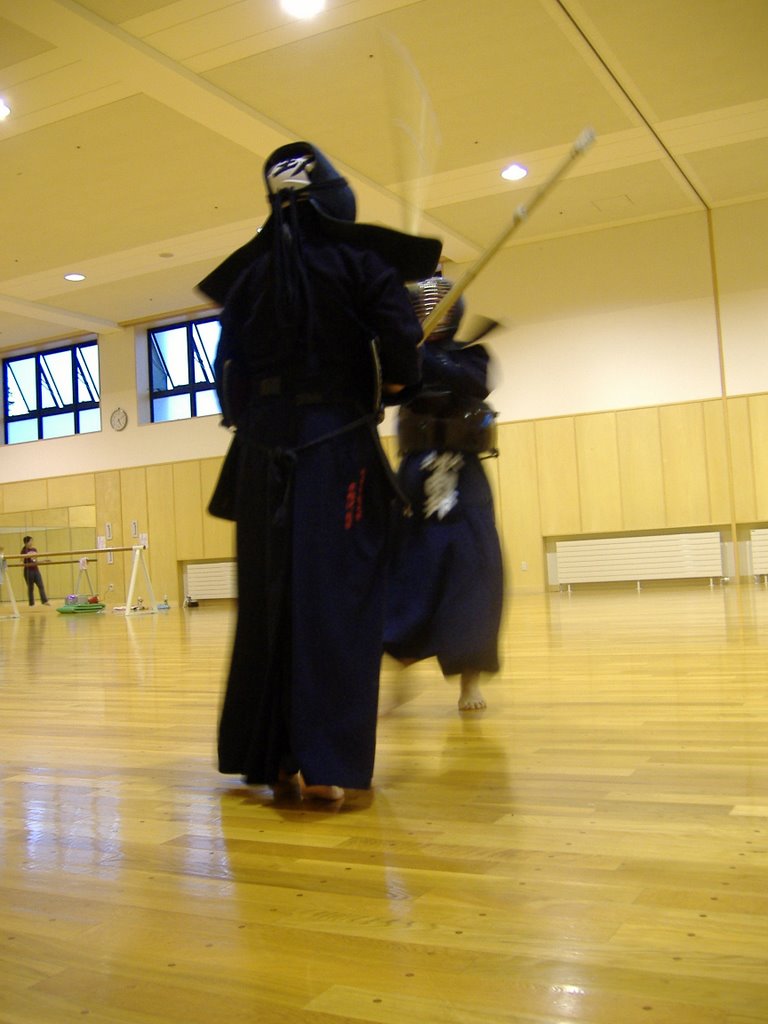
So last night I got a chance to practice with the kendo club which was a real treat! However, the kendo club here doesn't necessarly have a "Sensei". Rather, the club is ran by a small group of "Sempai" or the experienced members. So I went with a friend of mine to check it out and we were greeted warmly by the other members.

In minutes we were given a "Shinai" which is made of four bamboo slats (take) held together by two pieces of leather, tsuka-gawa (handle) and saki-gawa (tip), and a string (tsuru). Placed under the saki-gawa is a plastic plug saki-gomu. To prevent the four take from getting misplaced there is a small square of metal, chigiri, placed between them inside the tsuka-gawa. A leather thong (nakayui) is wrapped around the take and tied to the tsuru about one-third of the way down the shinai from the tip (kensen); this holds take together in the event of a break and marks the proper striking portion of the blade (datosubu).

We were told to line up with the other kendo class and ritually meditate and then thank the gym owners for the use of the gym by bowing to the ground this is called Sonkyo (I think).

Warm up came up next and we were to replecate simple drills that I tried, but was far from "good."

The Kendo class then split into groups and a member from the group came to Nick (my friend) and I and began instructing us on the basics of kendo starting with the foot stance, stride (or walk), the holding of a Shinai, and the forward and backwards walk with the shinai. It all seemed pretty easy, but in fact it was very difficult to get it right.

After getting the stance and the walk, we practiced drills with the shinai. The first drill had us moving across the floor with the shinai at a 45 degree angle. Nick and I went back and forth until our instructor said it was ok.

The next drill we did was called "Neh" where we were to strike the head of our opponent and call out "N~E~E~E~H!" This drill was followed by a simple Right/Left Strike to the temple of our opponent's head. (umm I should point out that these we're drills and everyone was completely safe and didn't get hurn during any of this)

The sempai put these two drills together to make a full drill. This full drill started with first taking a long forward stride while striking our partner's Shinai, then striking to the right, left, right, left, (then going backwards) right, left, right, left, right and then the final strike which we had to scream Meeeeeeeeeeeen! (x2).

We did about an hour and a half of these drills with breaks in between them. It was fun, I felt really tired and sore, but it was that real good sore feeling like you had worked new mustles. Out of all the pains I feel regularly, that "work out" pain feels the best. The night was over at 8:00pm so tired and hungry, my friend and I went out to get some Chinese food and some Sapporo Classic beer. It was a good night, I felt like I had done something cool and worth while.

Next practice is next Tuesday at 4pm I think... I can't wait.

~J out ya'll

*Edit:
Ok ya'll according to All United States Kendo Federation (AUSKF), the drill we did was called Kirikaeshi. This is the discription that they give:

Kirikaeshi is one of the fundamental learning tools used in Kendo. It contains 5 elements which are described by the metropolitan police as the following: 1. sho-men, 2. tai-atari, 3. four yoko-men forward followed by five backwards, sho-men, 4. four yoko-men forward followed by five backward, 5. sho-men followed by zanshin. Conceptually kirikaeshi develops strong ki-ai and breath control, large motion, correct cutting angle (ha-suji), correct grip (te-no-uchi), correct footwork (ashi-sabaki) all with ki-ken-tai-ichi. It also limbers the muscles, promotes harmonious action of the whole body and correct ma-ai, follow through with zanshin. Kirikaeshi is said to provide 10 virtues to the attacker and 8 virtues to the receiver. It makes the waza sharp and swift, strengthens the cut, builds stamina, relaxes the stroke and body, improves the motion of the body, improves dexterity and grip, improves the vision of the partner, improves the ma-ai, teaches mental tranquillity, improves observation of the opponent, makes the grip firm yet flexible. ~from http://www.auskf.info/main/study.htm


Where's the posts?

I know... I know you all want the bunraku report with pics and stuff and well I don't have it yet. Recently things have gotten busy with Japanese class. We're learning a lot of stuff at once as well as doing crazy readings like for example...

私の大学は国立大学です。大きくて新しい大学です。学生も先生も多いです。東京から少し遠いですが、大学の中は広くてとても静かです。東京駅の南口から。。。Yeah
I could go on, but you prob get the gist. Anyway.. Big festival coming up, "Matsuri" as they say. It's supposed to be a party time festival thingy. According to my Shinto Teacher the festival comes from a shinto religious event when all the shinto gods get together at this one place leaving the beer god to rule Japan for the month (I think)...

It's pretty cool in my opinion. Tomorrow though I'm going to try to make another flea market... then I'm going to check out this party going on in Sapporo.

So don't worry the 'posts' are coming!

~J out

Tuesday, October 03, 2006

Shall we ダンス?

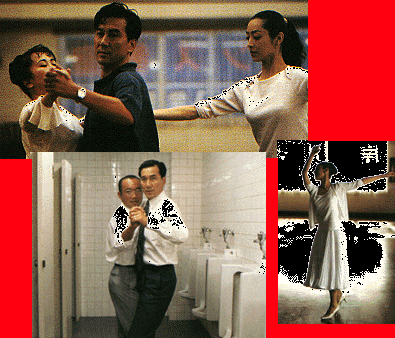
Today I had two classes: Japanese and Japanese Society. Japanese went on like it usually does with it's various lessons, but in Japanese Society we watched and discussed the famous movie "Shall We ダンス?" Or how they pronounce it Sharu-wii-dansu. It's a classic here and (for Clark College Students) a required movie for any Okuhara Sensei Japanese 100 level class! If you don’t know about the Japanese version, It was produced in roughly 1996 when Japanese businessmen had permanent jobs and permanent wives…

This version is somewhat different from the American version which I believe is basically a rip off the original Jap version. In the Japanese version, the plotline is more believable because the main character is played by a Kōji Yakusho (See Person on the right ) who is no Richard Gere. However, you all should know Yakusho’s later work in Memoirs of a Geisha where he played Nobu. If you still don’t know him look him up, because I think he’s a really great actor.

The plot line is more or less about an accountant Shohei Sugiyama (Kôji Yakusho) who is feeling bored with his routine life, limited to hard work and staying at home with his wife Masako Sugiyama (Hideko Hara) and his teenage daughter. One night, while traveling home by train, he sees the beautiful face of Mai Kishikawa (Tamiyo Kusakari) in the balcony of a dance school, and a couple of days later, he decides to visit the school and secretly take ballroom dance lessons every Wednesdays night. However, he becomes ashamed to tell his family his secret. Meanwhile, Masako feels the changes in the behavior of her happier husband, and hires a private eye to investigate whether Shohei is having an affair. While the private investigators look into Shohei’s life, Shohei is slowly falling in love with the art as well as the girl. It’s a funny and romantic movie that suitable for all audiences. The Japanese version comes with English subtitles as well so non Japanese Speaking people can enjoy it as well.

Another famous Japanese actor in this movie is Naoto Takenaka (Person on the left in the bottom left pic) who plays Mr. Tomio Aoki, the wild and crazy Mambo dancer. Takenaka has done jobs as an Actor, Director, Writer, Cinematographer, as well as himself. Some of you might know him as “Butterfly Joe” in Ping Pong (ピンポン), the wild and strict ping pong coach. I get the feeling that all his roles are the same exaggerated roles. Overall I think he’s a really good actor as well.

If you’re wondering why we’re watching this movie, I’ll tell you. The class is about Japanese society and this movie deals with the lifestyle of Japanese business men here in Japan. However, the drudgery of everyday “salary men” is changing. In Japan, it was common place for a Japanese man to land a job for life. In this movie it portrays this man as more of an “everyday man” doing things a traditional Japanese man wouldn’t do. This movie (some say) changed all that by making it “ok” for Japanese men in their 40’s and 50’s to do unordinary things then commute, work, eat, drink, and sleep. If any of you get the chance I strongly urge you to seek out the Japanese version and watch it.

After watching the first half the movie I had nothing to do so a friend of mine invited me to the Kendo club. In America I had practiced a little bit at a local Dojo, but I’m far from “good.” The club here is run by the more experienced students (Sempai) who teach the Kohai drills and offensive/defensive moves. Sometime I’ll drop by and practice with them.

Other news is that tomorrow I’ve been invited to see a Bunraku play (or a Japanese puppet show). You can obviously find all you need to know about Bunraku from (reliable) sources like wikipedia, but basically this is a traditional Japanese puppet show. I’m going to take a stab that this is a really old and often unheard of art to the Japanese, because my host mom has never heard about it.

I’ll write a formal analysis tomorrow.

Anyway what’s this Amish news I hear over here? What another shooting from a remote part of America? Whatever it’s about, it must be big if I’m hearing about here… ne?

Get’n late!

~J out

Monday, October 02, 2006

Cloudy and busy!

Welcome to October in Japan. The leaves are slowly dropping down earth colors of browns and oranges. The other day I felt a chilly draft go through the air. It was evident that winter is inching its way around here. The day time is a confortable 20 degrees (C), but night time is usually a drafty 14-16 degrees (C).

Here in Japan, costume stores in the train-stations are gearing up for Halloween. They do celebrate the event here on the 31st (tues). The costumes are somewhat simular too, except that there's costumes of some pretty scary gods or demons that are classic to the Buddhist sects. It all makes for one of those simular, but yet different kinds of events.

School is doing ok... It seems like just yesterday I was gearing up to go to Japan and it has already been nearly a month. Where does the time go? Today the school issued us our lunch money: 13,200 yen for the month. They told us that they thought 600 yen a day for lunch is fair. I guess so, for the most part I eat with everyone else in the lunch room. I've had my eye, however, on a cool ramen shop. Someday I'll head over there and get something cheap.

Right now I'm in study mode.. big test in a few days. Hopefully I'll make it through.

~J out